OHIP billing·
EH5 Error Code: Service Date Outside Eligible Period, Why Your Claim Was Rejected and How to Fix It
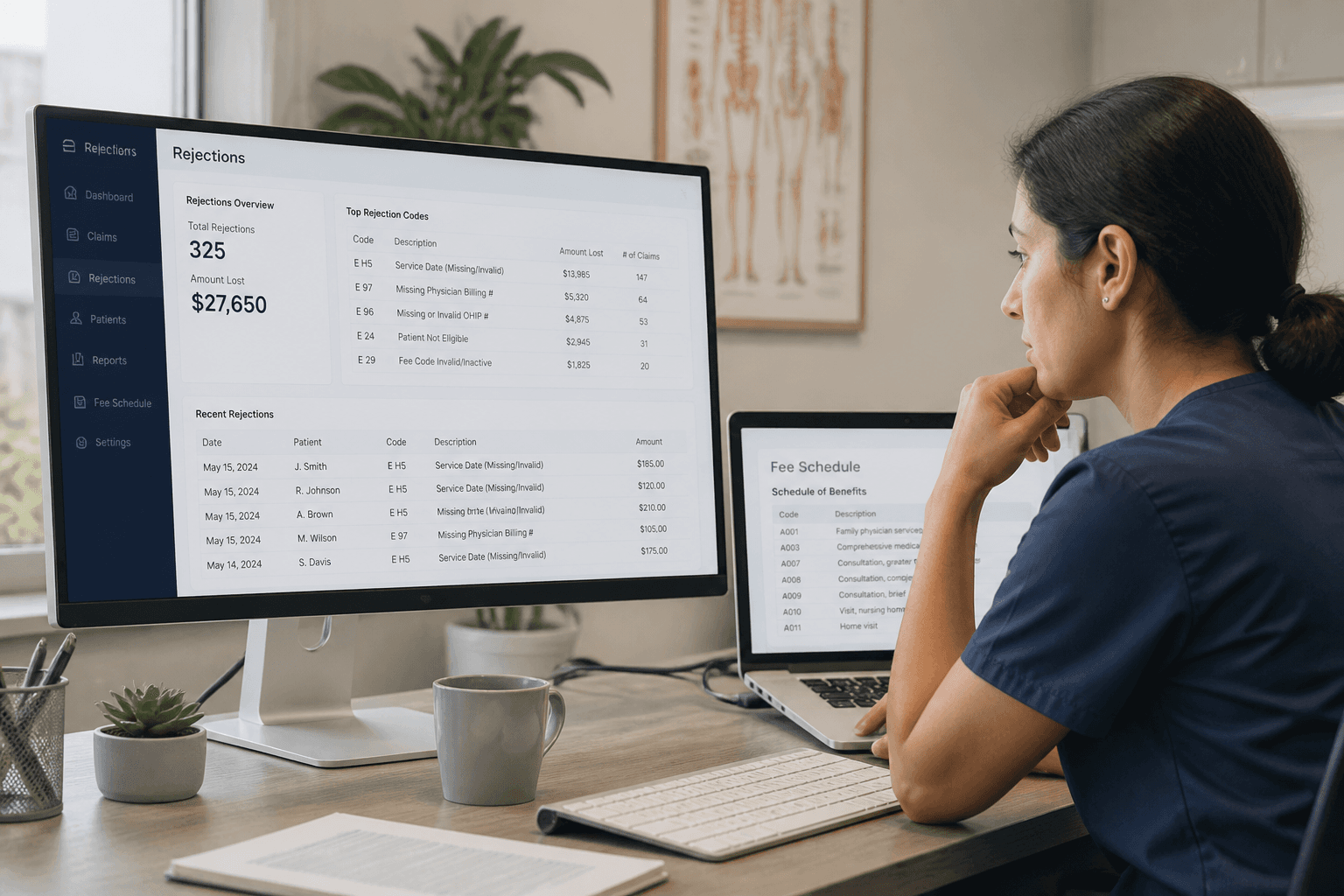
EH5 service date outside eligible period rejections are fixable, if you know the rule. Learn what triggers EH5, which fee codes are affected, and how to recover.
EH5 Error Code: Service Date Outside Eligible Period, Why Your Claim Was Rejected and How to Fix It
If you've pulled up your OHIP remittance advice and seen EH5 staring back at you, you know the feeling: you're confident the service was real, the patient was eligible, and yet the claim came back rejected. OHIP didn't explain itself. It just said the service date is outside the eligible period, and left you to figure out what that means.
For related context, see Your Path To Practicing In Ontario Starts Here Immigration Mindset Amp Initial Strategy. EH5 is one of those error codes that makes complete sense once you know the underlying rule, but the rule is buried in Schedule preambles and EPC Billing Briefs. It's just the reality of trying to run a clinical practice while also keeping pace with a billing framework that changes every year: the buried details and nuances are the difference between profit and loss.
What we want to do in this post is give you the full picture: what EH5 actually means, which fee codes and service types trigger it most often, how to recover the claims you already have, and how to stop the pattern from continuing. Because if you're seeing EH5 rejections, you're almost certainly losing revenue you earned, and spending admin time you don't have to recover it.
What EH5 Means: The Schedule Eligibility Window
The official explanatory code from MOH's remittance advice documentation describes EH5 as: the service date falls outside the eligible period for the service rendered.1
That sounds circular until you understand what "eligible period" means in OHIP's framework.
Every fee code in the Schedule of Benefits has conditions attached to it, not just what the service is, but when it can be claimed. For most services, this is straightforward: you see the patient, you bill the visit on the same day, done. But a meaningful subset of fee codes have specific date windows that govern when the service must occur relative to other services, when documentation must be complete, or how long after a triggering event the claim can be submitted.
When the service date on your claim falls outside that window, even by one day, even if you genuinely rendered the service, OHIP rejects it with EH5.
This is different from a late filing rejection (where the claim was submitted too long after the service date). EH5 means the service itself appears to have occurred at a time OHIP doesn't recognize as allowable for that code. The distinction matters because the fix is different in each case.
The EPC Billing Brief on requirements for time-based services makes this concrete: for interview fees, psychotherapy, and other time-based K codes, the service date and the documented start/stop times must align with the date the service was actually rendered.2 Claims submitted with dates that don't match the chart record, or that fall outside the code's defined usage window, are exactly what triggers EH5.
Common Scenarios: When the Date Mismatch Happens
EH5 isn't a single problem. It shows up differently depending on your specialty and workflow. Here are the patterns we see most often:
Retroactive billing beyond the permitted window. Walk-in clinics and urgent care settings sometimes batch their billing at the end of the week or the end of the month. If the service date on the claim is significantly later than when the patient was actually seen, or if the system auto-populates today's date rather than the encounter date, OHIP reads the service as occurring outside the eligible period. A claim for a K030 comprehensive visit dated a week after the chart entry will trigger EH5 before anyone reviews the clinical merits.
Multi-day procedures with start/completion date confusion. Surgical and anesthesia claims are particularly vulnerable here. The service date should reflect when the procedure was performed, not when the post-op note was dictated or when the case was closed administratively. With Bulletin 260304 introducing post-op unbundling effective April 2026, there are now specific date windows for post-operative care codes that didn't exist before.4 Practices billing R and E codes without updating their fee code library for these changes are seeing a new wave of EH5 rejections that weren't happening twelve months ago.
FHO+ hourly-rate claims with daily documentation gaps. For FHO+ physicians, direct care, indirect care, and clinical admin hours must be logged with a date, a time summary, and a description of activities, and the OMA has been clear that this documentation must be completed on the day of service, not reconstructed afterward.5 If a claim date doesn't match the logged daily summary, or if gaps in daily logging create ambiguity about when hours were worked, EH5 is a predictable outcome.
Emergency Department special visit premiums with time-stamp misalignment. Table V premiums for ED physicians and Table I premiums for other special visit categories each have specific rules about when the physician was at the hospital, when the call was received, and whether the service was rendered within the same shift. The EPC Billing Brief on ED special visit premiums is explicit: the date and timing of the request and the service must be documentable.3 A Friday overnight call where the service date was recorded as Saturday, even if technically accurate for a 1 a.m. service, can misalign with the on-call period in OHIP's system and produce an EH5.
The Real Cost of EH5 Rejections: Time, Revenue, and Attention
Here's where we want to be direct with you, because this is the part most billing resources skip.
Every EH5 rejection you receive isn't just a denied claim. It's a task that now lives on someone's desk. On average, working through a single rejected claim, identifying the root cause, pulling the chart, correcting the error, preparing the resubmission, and confirming it was received, takes between 15 and 30 minutes of skilled staff time. That's not a guess. That's the range we see when practices track this honestly.
If your practice is billing 200 or more claims per month and your EH5 rate is running at 3 to 5%, you're looking at 6 to 10 rejections per month. That's 1.5 to 5 hours of rework every month, just for EH5 alone. Over a year, that's somewhere between 18 and 60 hours, the equivalent of a full week of administrative or clinical staff time spent chasing errors that a cleaner process would have prevented.
And that's assuming you're catching all of them. Many practices don't audit their rejection patterns systematically. Claims are resubmitted once, maybe twice, and then written off when they don't go through. Revenue that was earned and documented just disappears.
The time cost compounds when we account for your attention, not just your staff's. Every rejection that escalates to your desk is a context switch, away from patient care, away from strategic decisions, and into a billing dispute that feels smaller than it is until you add up a year's worth of them.
We write about this pattern in more depth in our look at what DIY OHIP billing actually costs Ontario physicians. The math on self-managed rejections is rarely as favourable as it feels in the moment.
Even if you are genuinely good at billing, and many physician-owners are, the question worth asking is whether this is the right use of your capacity. And for the EH5 rejections sitting in your past remittance history right now, recovering those on your own is considerably harder than it sounds.
Schedule Requirements That Trigger EH5: Fee Code by Fee Code
Knowing which service types are most vulnerable gives you a practical checklist to audit against.
Time-based services (K codes, psychotherapy, psychiatric interviews). These codes require documented start and stop times on the day of service. The EPC Billing Brief on time-based services case-based billing includes worked examples showing how date and time mismatches cause rejections, and what compliant documentation looks like by contrast.3a A K029 psychiatric interview submitted with a date that doesn't match the chart timestamp, or with retrospective time entries, is a clean EH5 trigger.
Consultations and assessments (A and C codes). These codes must be billed within the context of an active specialist-patient relationship or referral. If the service date falls outside the window of an open referral, or if the claim date suggests the service occurred before or after the documented encounter, EH5 is the result.
Special visit premiums (H codes). Table V premiums for ED physicians are only valid when the physician was not already at the hospital when the request was made, and when the service was rendered within the same shift as the call. Date-stamp misalignment between the hospital's on-call log and the claim date is one of the most common triggers for EH5 in emergency medicine practices.
Surgical and anesthesia codes (R and E codes). Post-op care must now be billed within a defined window following the surgery date, as established by the April 2026 Schedule changes under Bulletin 260304.4 Practices that haven't updated their post-op billing workflows are submitting claims with dates that fall outside these new windows, producing EH5 rejections that look like errors but are really Schedule knowledge gaps.
FHO+ hourly-rate codes. The OMA's guidance on FHO+ hourly rate FAQs is clear that daily logs with date, time, and activity descriptions are non-negotiable.5 Gaps in logging, or dates that don't align with claimed hours, will be flagged.
How to Prevent EH5: Documentation and Submission Discipline
Prevention is straightforward once you know what OHIP is looking for. The challenge is building these habits into your workflow before a rejection teaches you the hard way.
Lock down start and stop time documentation on the day of service. For any time-based fee code, your EMR template should require start time and end time fields that auto-populate into the billing record. Never rely on retrospective reconstruction. The chart and the claim must agree, and they must both be dated the same day the service occurred.
Flag retroactive and urgent claims for manual review before submission. If a claim is being submitted more than a few days after the service date, it should go through a manual check before it hits the OHIP submission queue. This is especially true for walk-in visits, after-hours services, and anything that was documented late due to clinical volume.
Update your fee code library for April 2026. Bulletin 260304 changed the rules for post-operative care, MAID services, and the new Occupational Medicine specialty category. If your billing software hasn't been updated with these changes, you're submitting claims under old date-eligibility assumptions, and EH5 rejections are the predictable result. Verify with your billing software vendor that the April 2026 Schedule update is reflected in your current code library.
Build an ED documentation workflow that captures on-call timing. For emergency department special visit premiums, your practice needs a consistent method for recording the time the call was received, the physician's location when paged, and the time service was rendered. Without that, you're relying on memory and hospital logs that don't always align with claim dates.
FHO+ practices: daily log, every day. The OMA has been explicit that daily summaries for FHO+ hourly-rate claims are required, and that these must be completed contemporaneously.5 Building this into your end-of-day routine, even if it's a two-minute activity summary, is the single most effective prevention for EH5 rejections in this service type.
This kind of operational discipline connects directly to how your broader clinic revenue strategy holds up over time. Our piece on proven healthcare marketing strategies for Ontario physicians' clinic revenue touches on how documentation and billing discipline underpin everything else you build.
Recovering EH5 Rejections: Resubmission Strategy and Timeline
When you already have EH5 rejections in your remittance history, the recovery path depends on which of three root causes is in play.
Root cause 1: The claim date was entered incorrectly, but the service was rendered on an eligible date. This is recoverable. Pull the chart note, confirm the actual service date, and resubmit with the corrected date. Include documentation that establishes the genuine service date, a chart timestamp, a facility log, or a contemporaneous note. Submit promptly; OHIP's resubmission windows are tight, and the longer you wait, the more risk of denial.
Root cause 2: The service date is correct, but the documentation doesn't support it. This is harder. If your chart note was written after the fact, or if the time entries don't align with the claim date, resubmitting the claim with the same date will likely produce another EH5. The appropriate step is a dated addendum to the medical record, not a retroactive rewrite, but a clearly labelled correction that explains what was missed and when. Consult OMA Physician Advisory Services for guidance on chart amendment best practices before proceeding.
Root cause 3: The service genuinely fell outside the eligible window. This claim is not recoverable through resubmission. Your options are to assess whether a Schedule-based appeal is warranted, or to write off the claim and focus on preventing the same pattern going forward.
Batch your recovery work. If you have 12 EH5 rejections in the past two months, the worst thing you can do is tackle them one at a time. Sort them by error type first. Are they clustered in one service line, all ED premiums, all FHO+ hourly claims, all post-op codes? If so, the root cause is likely the same for all of them, and you can address it once, write a cover explanation for the batch, and submit through your billing partner or via the OHIP claims contact centre. Batch recovery is significantly more efficient than individual claim-by-claim rework.
Watch the resubmission clock. EH5 rejections need to be addressed quickly. While OHIP's remittance advice will specify applicable re-claim deadlines for your specific code set, there's no universal grace period. Missing the resubmission window converts a fixable rejection into permanent lost revenue. Prioritize by dollar value if you're triaging a backlog.
For a broader look at how billing errors compound into revenue leakage, and why understanding your rejection patterns matters as much as fixing individual claims, our post on what medical school didn't teach you about OHIP and Medicare billing covers the foundational visibility gaps that most practices are navigating without realizing it.
The Bigger Question Behind Every EH5
Here's the thing about EH5: it's a symptom. The rejection code tells you a date was wrong. What it doesn't tell you is whether that date error was a one-time data entry mistake, a documentation habit that's been producing quiet losses for months, or a Schedule rule change that your billing setup hasn't caught up with.
Most practices don't find out which it is until they audit their rejections by code and by root cause. And most practices don't do that audit because it takes time, requires billing expertise, and competes with everything else you're managing.
EH5 rejections are one of the high-frequency billing errors we look at when we audit a practice. Fixing them is often part of a larger revenue-recovery engagement, one where the value isn't just in recovering the specific claims, but in identifying why the pattern exists and what it takes to break it. Practices that fix the process, not just the claims, typically recover 2 to 4% of billing revenue that was quietly slipping out through documentation gaps and Schedule knowledge mismatches.
That recovery is consistent with what we see across the practices we work with: 20 to 40% or more of lost revenue tied to oversights and invisible process drift that no one inside the practice had the angle to see.
The question we'd ask you is this: even if you're good at billing, is working through 6 to 10 EH5 rejections a month the best use of your clinical mind? And for the rejections already sitting in your past remittance history, do you have the bandwidth to recover those systematically?
If you're not sure, a fresh set of eyes on your billing patterns is a good place to start. Book your free OHIP billing review with the Physicians First team, we'll look at your rejection profile, identify where EH5 and other errors are clustering, and give you a clear picture of what recovery looks like.
Stay connected

Frequently Asked Questions
Can I resubmit an EH5 claim with a different service date if my chart note doesn't match?
No. The service date on the claim must match the date documented in the medical record. If the record shows one date, the claim must show that date. If the service was genuinely rendered on a different date, the chart needs a clearly labelled, dated addendum, not a retroactive rewrite. Consult OMA Physician Advisory Services for guidance on chart amendment best practices before proceeding with a correction.
My ED physician was called after-hours and I submitted the claim with the correct date, but I still got EH5. Why?
EH5 can occur when the date is technically correct but doesn't align with OHIP's eligible-period rules for Table V or Table I special visit premiums. For Table V to apply, your physician must not have been at the hospital when the call came in, and the service must have been rendered within the same on-call shift. If on-call status, time of request, and service time aren't clearly documented and aligned, OHIP flags the service as outside the eligible window. Clarify the on-call documentation with your hospital and resubmit with full time-stamp support.
We have 12 EH5 rejections from the past two months. What's the fastest way to recover them?
Sort them by root cause before doing anything else. Are they all the same type of service? All from the same billing period? If there's a common thread, missing time stamps on K codes, for example, or FHO+ daily logs that weren't completed, you can address the root cause once, prepare a batch correction with a cover explanation, and resubmit together. That's significantly more efficient than correcting 12 claims individually. Prioritize by dollar value if you can't address all of them at once, and aim to resubmit within 30 days of the original rejection notice.
What if my billing software auto-populated the wrong service date and sent it to OHIP?
Contact your billing software vendor immediately and ask them to audit your claim submission templates. If the system is systematically entering incorrect service dates, you need that fixed before your next submission run. In the meantime, pull your last 50 to 100 claims and check whether the service dates in OHIP's system match your chart records. If you find systemic mismatches, work with your billing partner or the OHIP claims contact centre to file a batch correction request. This is one of those situations where the scale of the problem makes self-remediation genuinely hard.
Is EH5 the same as a late-filing rejection?
No, and the distinction matters for how you respond. A late-filing rejection means the claim was submitted too long after the service date, beyond OHIP's timely-filing window. EH5 means the service date itself falls outside the eligible period for that code, regardless of when the claim was submitted. A claim can be filed promptly and still receive EH5 if the service date doesn't align with the code's allowable date range. For example, a K code submitted within 30 days of service but with a date that doesn't match the chart timestamp is timely filed but still EH5-eligible. Always check the specific fee code's date requirements against the current Schedule before resubmitting.
References
-
Ontario Ministry of Health. Remittance Advice Explanatory Codes (March 2026, effective April 7, 2026). https://www.ontario.ca/files/2026-04/moh-remittance-advice-explanatory-codes-en-2026-04-07.pdf
-
Ontario Ministry of Health, Education and Prevention Committee. EPC Billing Brief: Requirements for Time-Based Services. https://www.ontario.ca/document/education-and-prevention-committee-billing-briefs/requirements-time-based-services
-
Ontario Ministry of Health, Education and Prevention Committee. EPC Billing Brief: Emergency Department Special Visit Premiums. https://www.ontario.ca/document/education-and-prevention-committee-billing-briefs/emergency-department-special-visit
-
Ontario Ministry of Health, Education and Prevention Committee. EPC Billing Brief: Time-Based Services Case-Based Billing. https://www.ontario.ca/document/education-and-prevention-committee-billing-briefs/time-based-services-case-based-billing
-
Ontario Ministry of Health. Bulletin 260304: Physician Services Agreement Related Fee Schedule Code Adjustments, April 2026. https://www.ontario.ca/document/ohip-infobulletins-2026/bulletin-260304-physician-services-agreement-related-fee-schedule
-
Ontario Medical Association. FHO+ Hourly Rate Frequently Asked Questions. https://www.oma.org/practice-professional-support/starting-your-practice/fho-is-the-future-of-family-medicine/fho-hourly-rate-frequently-asked-questions/